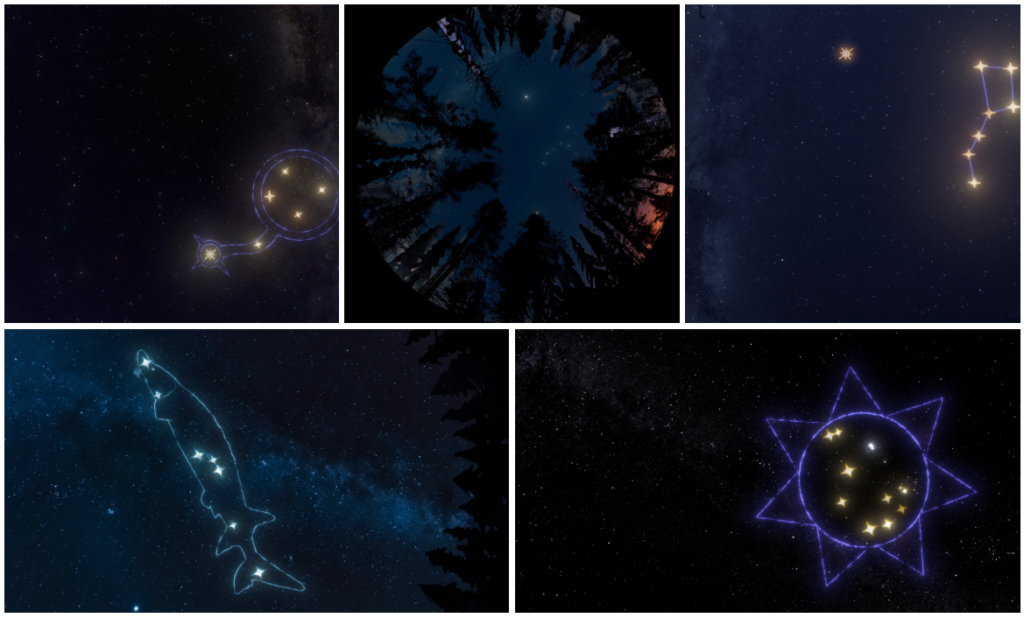
Wilfred Buck’s Star Stories – A Planetarium Experience That Reconnects Us to the Sky
Canadians have been involved in space science since the very beginning. With Canada Day having just passed, we thought it fitting to continue the celebration by highlighting some of our country's greatest contributions to space travel and exploration. From our first steps into space with the Alouette I satellite, all the way to our current contributions to NASA's endeavour to return to the Moon, Canadians have and continue to play an integral role in studying the universe.
Alouette I: Canada's Entry Point to the Space Age
It was with the successful construction and launch of the Alouette I satellite that Canada found its point of entry into the space age. This satellite was developed in response to a call from the recently formed NASA back in 1958. They were looking for international collaboration on their rapidly developing satellite program, and Canada responded within mere months of their request.
Image (right): The Alouette I Satellite. Credit: CSA

The proposal for Alouette I was submitted by Josh Chapman and Eldrin Warren, two scientists at Canada's Defence and Research Telecommunications Establishment. Their proposal was to design and build a satellite that would study and monitor the electrically charged region of the Earth's upper atmosphere called the ionosphere from up in space. The concept was approved by NASA on the 11th of March 1959 and following three and a half years of design and construction, the completed Alouette I satellite was launched into orbit. This didn't come without obstacles, however. One of the biggest challenges faced by Alouette I engineers was that data couldn't be stored on the satellite at this point in history. The solution to this problem was to transmit the data it collected to several different ground stations across the globe so that it could be recorded for use.
Alouette I was launched from the Pacific Missile Range in California on September 29th, 1962, marking Canada as the third nation to have successfully designed, built, and launched a functional artificial satellite into space behind the USSR and United States. It was a massive success for our country, collecting millions of photos of the ionosphere from space and massive amounts of scientific data. It far exceeded its single-year design life and continued operating for ten years before it ceased all activity on September 30th of 1972.
Following the success of Alouette I, an improved version of the satellite, Alouette II, was launched in 1965. Even more so, its achievements prompted a partnership between Canada and the US to launch even more satellites designed to study the ionosphere. This new collaboration came in the form of the International Satellites for Ionosphere Studies (ISIS) program. The ISIS I and ISIS II satellites were subsequently launched in 1969 and 1970 respectively.
Canadarm

Canadian innovation in space technology did not end with satellites. Back in 1974, NASA awarded Canada with the responsibility of designing, developing, and building the Shuttle Remote Manipulator System (SRMS) for the space shuttle. What resulted was arguably Canada's most well-known contribution to space technology, Canadarm. This was a 15-metre-long robotic arm designed to deploy and receive payloads in space, and it was launched onboard the Space Shuttle Columbia on the 12th of November 1981. Throughout its lifetime, Canadarm worked flawlessly on 90 shuttle missions and spent a total of 944 days in space before it touched down on Earth in July of 2011.
Image (left): Canadarm. Credit: NASA
Canadarm's successor, Canadarm2, is a 17.6-metre-long robotic arm that was delivered to the International Space Station (ISS) in 2001 by Canadian astronaut Chris Hadfield. It was designed to also assist in spacewalks as well as the deployment and retrieval of equipment and supplies for the space station.
Although Canadarm2 is still operating on the ISS today, plans for a Canadarm3 are tentatively in the works. Back on February 28th of 2019, then Prime Minister Justin Trudeau announced Canada's commitment to partner with NASA on Gateway, a potential space station in orbit around the Moon. This new version of the robotic arm would feature a highly autonomous robotic system in order to perform tasks around the Moon without the need for any human intervention. Unfortunately, plans for Gateway have been put on pause by NASA, and because of this, Canadarm3's future is currently up in the air.
Canadian Astronauts
It was because of Canadarm that Canadians were given the chance to fly in space. Its massive success on the Space Shuttle mission was rewarded by NASA with an invitation to bring their very own astronauts into space, ultimately launching the beginning of the Canadian astronaut program. The first Canadians selected were Roberta Bondar (the first female Canadian astronaut), Marc Garneau, Steve MacLean, Ken Money, Robert Thirsk, and Bjarni Tryggvason on the 5th of December 1983.
Marc Garneau

Image: Marc Garneau. Credit: CSA
From the six people selected for the Canadian astronaut program, it was Marc Garneau who ultimately became the first Canadian in space. He was a payload specialist on mission STS-41-G onboard the Challenger between the 5th and 13th of October 1984, but his adventures in space did not end there. On July 3rd of 1992, he and another notable Canadian astronaut, Chris Hadfield, were selected to become the first Canadian mission specialists. Garneau was the first non-American Capsule Communicator (Capcom) at Mission Control in Houston, Texas, on the second international microgravity lab mission—a Canadian experiment concerning the physiological changes that occur in the human spine in microgravity.
Garneau was the first Canadian astronaut to not only fly in space twice, but thrice as well. As a reward for his great achievements on the frontiers of the Canadian astronaut program, he became the Canadian Space Agency's (CSA) president on the 28th of September 2001.
Chris Hadfield

Image: Chris Hadfield. Credit: NASA
Following in the footsteps of his fellow mission specialist trainee in Houston, Chris Hadfield also became a notable member on the roster of Canadian astronauts. He was selected for the Canadian astronaut program on the 8th of June 1992 from 5330 different applicants and completed his mission specialist training alongside Garneau on September 2nd of 1994. He was assigned to mission STS-100, the second Shuttle-Mir Docking Mission taking place between the 19th of April and 1st of May in 2001. On this mission, he delivered Canadarm2 to the ISS and became the first Canadian to perform a spacewalk. On his third return to space on expedition 34/35, a 5-month mission onboard the ISS, he became its first Canadian Commander on March 13, 2013, during the second half of this expedition. This made him responsible for decision-making in the event of an emergency as well as for overseeing various station operations.
Chris Hadfield retired from the CSA on July 3rd of 2013. Since then, he began work as an author, publishing books such as An Astronaut's Guide to Life on Earth and more recently, Final Orbit. He is the current CEO of Chris Hadfield Inc., and frequently appears in documentaries and podcasts where he continues to inspire curiosity in others about space.
Jeremy Hansen

Image: Jeremy Hansen. Credit: CSA
You're likely already familiar with one of our most recent Canadian astronauts, Jeremy Hansen. He was selected alongside David St-Jacques on the 13th of May 2009 as the first Canadians to join the astronaut corps since 1992. He completed his training in Houston on September 8th of 2011 and participated in NEEMO 19, the NASA Extreme Environment Mission Operation. On this mission, he lived in Aquarius, an underwater habitat 19 meters below the surface of the ocean, which serves as a weak-gravity environment analogue situated here on Earth. Missions like these help astronauts to test exploration concepts that could be used in space environments like asteroids, the Moon, or even Mars.
On April 3rd, 2023, Hansen was announced as the first Canadian to take part in the Lunar Mission Artemis II. Three years later, between the 1st and 10th of April of this year, he embarked on a journey around the Moon onboard the Orion spacecraft, marking him as the first Canadian to perform a lunar flyby.
Recently, Hansen announced that he'll be stepping down from his full-time role with the CSA, but still hopes to continue supporting Canadian space endeavours.
The Next Canadian in Space
Later this year, Joshua Kurtryk will become the next Canadian in space when he embarks on a mission to the ISS. He was selected in 2017 alongside Jenni Gibbons as CSA astronauts. While there are currently no plans for her to fly yet, she served as both Jeremy's backup and as a Capcom for the Artemis II mission. She has also been assigned as Lead Capcom for the Artemis III mission scheduled to launch sometime next year.
Images: Joshua Kurtryk (left) and Jenni Gibbons (right). Credit: CSA


It goes without saying that Canadians have played an important role on the frontiers of the space age. Our successes in satellite technology inspired many collaborations with big names in the space science industry, and our achievements with Canadarm on the Space Shuttle helped to pave the way for our very own astronauts to make their mark in history. The best part? It's not over yet! Canadians today are still involved in space exploration and innovation, and we look forward to seeing what we'll accomplish next!
Written by: Maya Elliott