Did you know that the last time humans visited the Moon was in 1972?
And did you know that the next time humans will be visiting the Moon again will be in 2026?
That’s right- after over 50 years apart, we’ll be reunited with our cosmic neighbour this April, as four astronauts embark on a journey that will take them farther into space than we’ve ever been before.
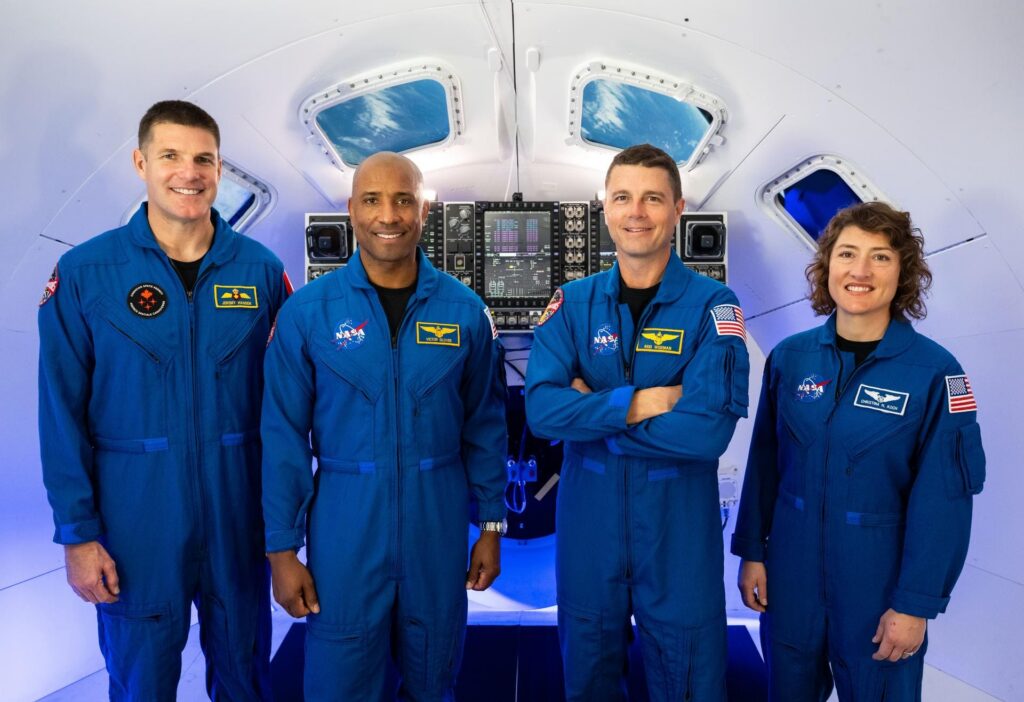
On Wednesday, at around 3:30PM PT, Jeremy Hansen, Christina Koch, Victor Glover, and Reid Wiseman will blast off from the Kennedy Space Centre in Florida. Their 10-day mission will involve a flyby around the Moon in a trajectory which loops out to almost half a million kilometres from Earth.
This adventure is just the second of many which form the Artemis program, an international effort to send humanity back to the Moon. Phase one was successfully completed in November 2022, when the rocket (the Space Launch System, or SLS) and spacecraft (Orion) were put to the test on an uncrewed orbit of the Moon. The success of this phase was the green light for week’s launch, Artemis II, which will be followed next year by Artemis III, when a crew will assess how SLS and Orion fare in Earth’s orbit. If all goes well, humans will finally return to the lunar surface in 2028 with Artemis IV. From then on, NASA intends to schedule a Moon landing every year.
The motivation for the Artemis program is ambitious: our sights are set on eventually establishing a permanent off-world presence as a stepping-stone to further targets, such as Mars (in fact, NASA announced a $20 billion upgrade to their plans for a lunar base just a few days ago). The site selected for this settlement is the lunar South Pole, where water-ice is known to exist in deep craters, sheltered from sunlight. Accessing this ice has both scientific value, potentially providing clues as to how water arrived on Earth, as well as practical value, as future crews may be able to use it as a resource. The complexity of such an endeavour is part of the reason why it’s taken us so long to return to the Moon.
Artemis is not just about tangible scientific goals, though. Part of what makes this mission so special is its departure from the singular themes of Apollo, which was all-American, all-male, and all-white. Excitingly, Artemis will see the first woman, the first person of colour, and the first non-American (a Canadian!) travel to the Moon. And it’s not just the US and Canada who have a stake in the game- the mission is bringing together talent from across the globe, with participation from space agencies in Japan, the UAE, and Europe.
As an international collaboration full of firsts, Artemis is paving the way for a new dawn of space exploration. The world will be watching- will you?
This article is written by Dr. Rosanna Tilbrook, Astronomer at the H.R. MacMillan Space Centre.